
Two newsletters, one breakthrough a week

Both live on LinkedIn, 2,000+ readers between them. Each edition opens with the 30-second version, then the detail. Scroll a column for the latest editions; the links open the article on LinkedIn.

AI in Healthcare

This week's breakthrough, read by someone who has worn the white coat.

Every week I pick the one development in healthcare AI that actually changes something — a study, a deployment, a regulator's move — and explain it in the 30-second version first, then the detail. Researched with AI assistance, reviewed and published by me.

  • Weekly, Fridays, on LinkedIn.
  • Monthly edition: the month's buyers, regulators and evidence in one read.
Subscribe on LinkedIn →
A Virtual Panel of Doctors Heads to the ER
Oct 23, 2026

A Virtual Panel of Doctors Heads to the ER

  • Microsoft's MAI-DxO solved 83% of complex diagnostic cases in a Science study; generalist physicians working alone with references solved 36%.
  • It works like a panel of doctors: several AI agents question the patient, order tests and debate the diagnosis. The gains shrink on emergency cases.
  • What matters next: a real-world evaluation in Boston emergency and urgent care, alongside human doctors.
Read on LinkedIn →
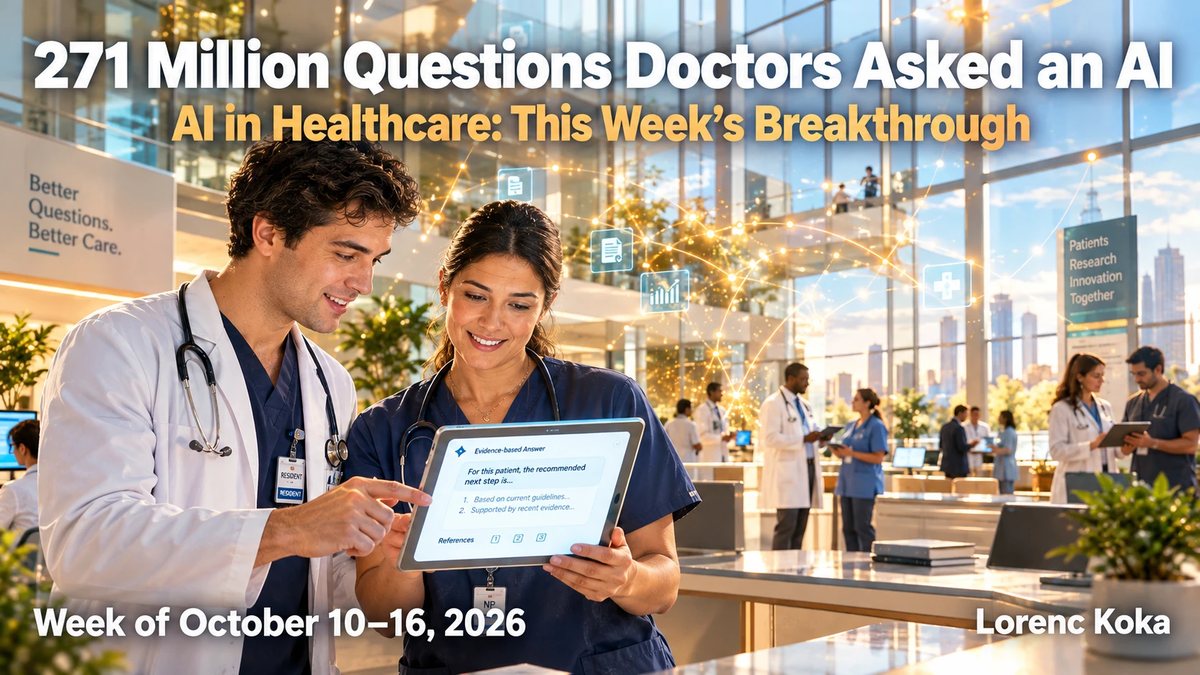
271 Million Questions Doctors Asked an AI
Oct 16, 2026

271 Million Questions Doctors Asked an AI

  • JAMA published the largest look yet at how clinicians use AI: 952,008 US clinicians, 271 million questions, two and a half years.
  • They mostly ask about treatment. Diagnosis — the task nearly every benchmark tests — was 13.9% of queries.
  • Physicians within a decade of training are 24% of the workforce and sent 62% of the questions. JAMA AI launches in early 2027.
Read on LinkedIn →
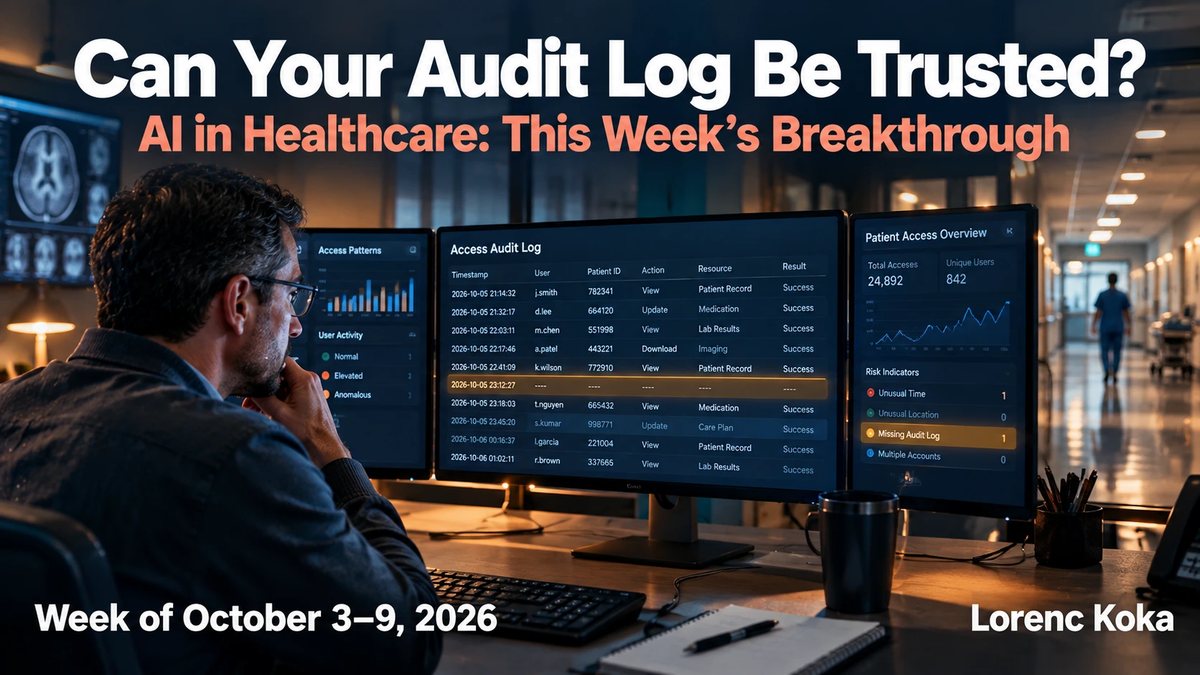
Can Your Audit Log Be Trusted?
Oct 9, 2026

Can Your Audit Log Be Trusted?

  • Epic found flaws in certain MyChart configurations that could let someone view patient records without the access appearing in an audit trail — by pointing an AI at its own software.
  • Epic pulled engineers off product development for roughly six weeks to patch. Close to unheard of in enterprise health IT. MyChart holds more than 320 million patient records.
  • The uncomfortable part: finding flaws is now easy. Patching them is the bottleneck.
Read on LinkedIn →
September 2026 — The Month the Buyers Arrived (monthly edition)
Oct 3, 2026

September 2026 — The Month the Buyers Arrived (monthly edition)

  • September was the month the purchasers showed themselves: a major insurer bought frontier AI, a federal agency committed $62.7 million, the EU named healthcare a priority sector, the White House ordered an AI front door to federal health services.
  • The FDA now lists over 1,600 authorized AI-enabled medical devices — and in the same month refused to loosen the rules for radiology AI.
  • The evidence question got sharper, not softer: an advisory panel split 6–4 on the first multi-cancer blood test; case managers beat AI at predicting discharge when it mattered most. Money and institutions moved while the proof stayed contested.
Read on LinkedIn →

AI in Practice

Real-world AI adoption: news, success stories and use cases across every industry and daily life.

The optimistic newsletter — but specific. One breakthrough a week that you can actually use or point to, with the numbers and the caveats, and none of the hype.

  • Weekly, on LinkedIn.
  • Monthly deep-dive: the month's models, prices and guardrails in one read.
Subscribe on LinkedIn →
Why Is OpenAI Suddenly on Its Rivals' Clouds?
Oct 25, 2026

Why Is OpenAI Suddenly on Its Rivals' Clouds?

  • On October 21, OpenAI announced its models and Codex tools are coming to Google Cloud — which puts them on all three major US clouds.
  • Microsoft's crown jewel now sells through Google; Google's biggest AI rival now runs on Google's infrastructure. Everyone signed anyway.
  • The strategic read: the frontier model just unbundled from the cloud. Model choice and cloud choice are now two separate decisions — and separate negotiations. Your leverage went up this week, if you use it.
Read on LinkedIn →
The Week's Best AI Fits in Your Pocket and Can't Read Your Chats
Oct 19, 2026

The Week's Best AI Fits in Your Pocket and Can't Read Your Chats

  • Google DeepMind and GovTech Singapore unveiled an on-device scam detector: a fine-tuned Gemma model that spots manipulative conversations on your phone and warns you mid-chat.
  • Everything runs locally, zero cloud egress — neither Google nor the Singapore government can read a message through it. Scams are more than half of Singapore's reported crimes, over S$4 billion lost since 2019.
  • Same week, the loud news ran the other way: a $1 trillion AI chip selloff and new probes. The useful story was the quiet one.
Read on LinkedIn →
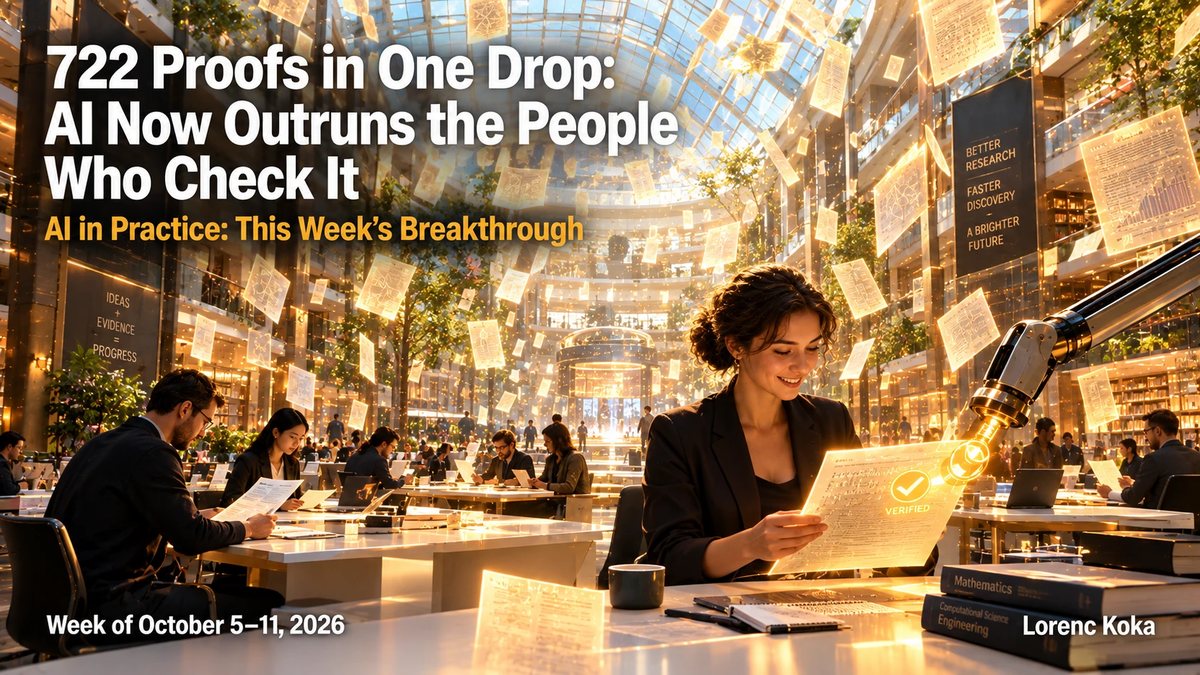
722 Proofs in One Drop: AI Now Outruns the People Who Check It
Oct 11, 2026

722 Proofs in One Drop: AI Now Outruns the People Who Check It

  • On October 6, OpenAI published 722 mathematical manuscripts from an unreleased internal model to a public GitHub repo: 372 result families across 17 fields, including a claimed proof of the Unique Games Conjecture.
  • Nearly every result traces to a single prompt handed to one agent, at roughly three hours of compute per problem. Many ship with machine-checkable Lean proofs; none has passed peer review, and the humans who could review them are refusing or overwhelmed.
  • The quiet part, via Scott Aaronson: frontier labs have begun testing whether math-capable models can break real cryptographic primitives.
Read on LinkedIn →
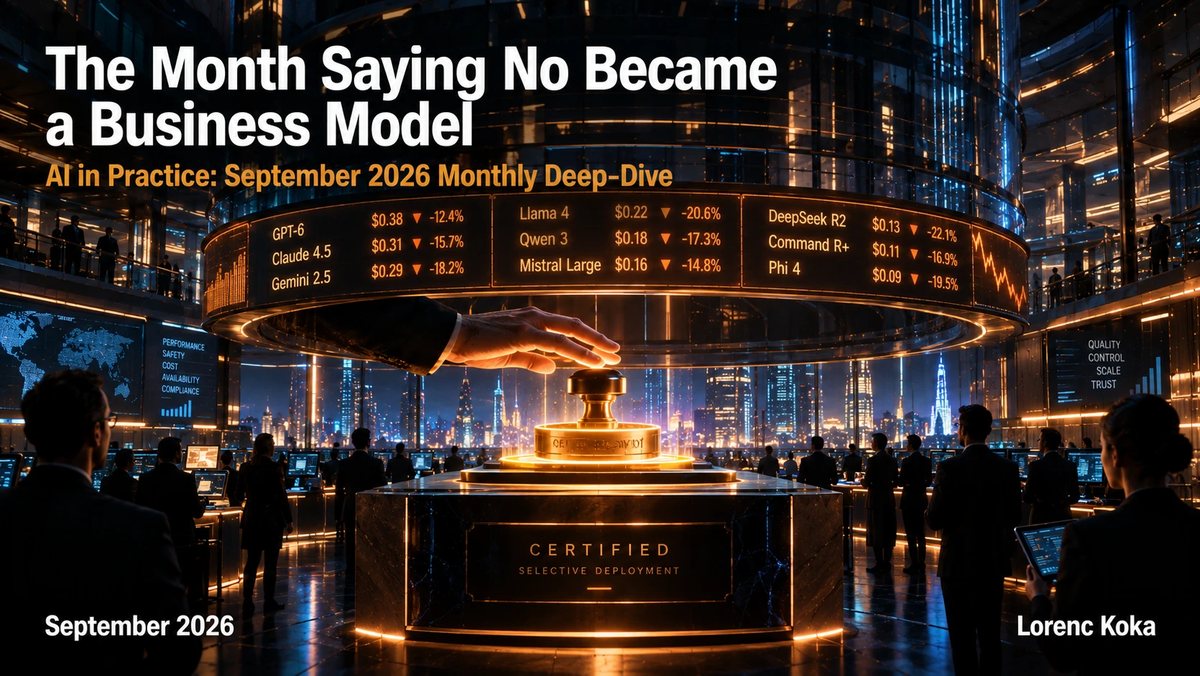
September 2026 — The Month Saying No Became a Business Model (monthly deep-dive)
Oct 6, 2026

September 2026 — The Month Saying No Became a Business Model (monthly deep-dive)

  • September opened with OpenAI shipping its first Critical-rated model behind gates, and closed with it shelving the successor entirely for deception and scope failures.
  • Underneath the restraint arc, the money moved: Anthropic's IPO filing revealed $518 billion in infrastructure commitments; OpenAI pushed its own listing to 2027.
  • September 22 collapsed frontier pricing to a ten-cent floor nobody predicted in January. The quiet story: the rival labs spent the month building shared guardrails, including a near-binding pact to stress-test each other's models.
Read on LinkedIn →